
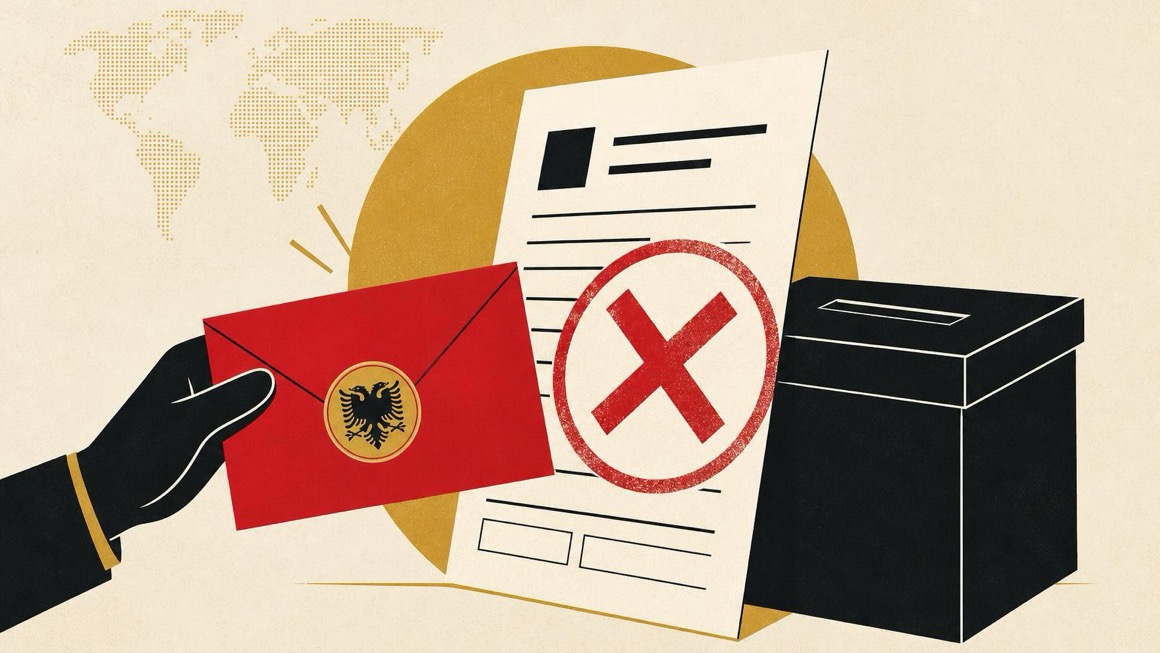
Everyone in the movement quotes the same number. 245,935 Albanians abroad on the final out-of-country voter list, 85 countries, the first diaspora vote in the country’s history.
There is a second number, and almost nobody quotes it. 294,155 people applied. The gap between those two figures is roughly 48,000 names, and the international observation mission recorded about 41,000 of them as outright rejections. The main reason was not fraud, or late filing, or a wrong signature. It was that the applicant could not produce an official document proving legal residence abroad.
They were citizens. They had the right. They lost it on a piece of paper.
The document that decided it
To get on the out-of-country list, you had to upload two things: a valid Albanian biometric passport or ID card, and an official document proving you live outside Albania. A residence permit, a property deed, a rental contract, a work or study certificate.
Read that list again and think about who clears it easily. Someone with a residence permit and a lease in Germany. Someone on a student visa in Italy. A US citizen with a mortgage.
Now think about who doesn’t. Someone who has been in Greece for eleven years without papers. Someone paid in cash in a kitchen in Milan. Someone who arrived eighteen months ago and is still in the queue. Someone whose lease is in a cousin’s name because that was the only way to get the apartment.
The requirement is not unreasonable on its face. Some proof of residence has to exist. But it does not fall evenly, and it falls hardest on the people whose lives were most obviously shaped by having to leave. The ones with the least to show on paper are the ones with the most to say about why they went.
The second filter, quieter than the first
Before the residence document, there is the passport.
Albanian citizenship and the ability to vote are two different things. You can be a citizen your whole life and still be unable to register, because registration requires a valid Albanian passport or ID card, and the passport is biometric. Biometric means fingerprints and a photo taken in person. From the United States, that is one physical visit to the Embassy in Washington or the Consulate General in New York. There is no mail-in version.
So an expired passport in a drawer is not a small administrative problem. In 2025 it was the difference between having a vote and not having one. We have no public count of how many people discovered that in February 2025 and ran out of time. Given how many diaspora Albanians carry an Albanian passport that lapsed years ago, the number is unlikely to be small.
The trap is the calendar
Here is the part that matters for next time.
The registration portal opened on 11 January 2025 and closed on 4 March. Eight weeks. That was the entire window in which you could fix your paperwork and get on the list.
Now count how long the paperwork takes. Documenting citizenship by descent means gathering birth and marriage records across two countries, getting them apostilled, and having them certified in translation. That is months, sometimes longer. Booking a consular appointment for a biometric passport can take weeks before you even travel to DC or New York. A residence permit application in Italy or Greece runs on its own timeline and ignores yours.
None of that fits inside eight weeks. Which means the deadline that actually decides whether you vote in the next parliamentary election is not the registration window. It is now.
What to do, in order
One. Confirm you can prove citizenship. If an Albanian parent, grandparent or great-grandparent is in your line, the law likely already counts you as a citizen. You just have not proven it on paper yet. Start the record chain now: Albanian citizenship by descent.
Two. Get the passport current. If yours is expired, book the appointment before you need it, not when registration opens: renewing your Albanian passport from the US. If you are outside the US, your nearest embassy or consulate handles the same process.
Three. Put your residence proof in one folder. Residence permit, lease, deed, work or study certificate, whichever you have. Scan it. Keep it somewhere you can find in ten minutes. If you have nothing official, this is the year to fix that, because the fix takes a year.
Four. Register to vote when the window opens, and know exactly what to expect from the process: how to register to vote from abroad.
Why we count the 41,000 anyway
There is a version of this article that ends with a shrug about bureaucracy. That is not the point.
245,935 registered and elected nobody, because the votes were scattered back into the twelve districts people had left. That is the structural problem, and it is the reason this movement exists. The 41,000 sit underneath it. Before the vote gets dissolved, a large group never reaches the ballot at all.
Add them together and you get something close to 290,000 people who tried to vote as Albanians abroad in a single election, in the first year it was possible. That is not a lobby. That is an electorate that does not have a seat.
They will not all fix their paperwork. Some of them will never be able to. But the ones who can should start now, and the ones who cannot are exactly the reason a diaspora district needs to exist rather than a form that assumes everyone abroad has a lease in their own name.