
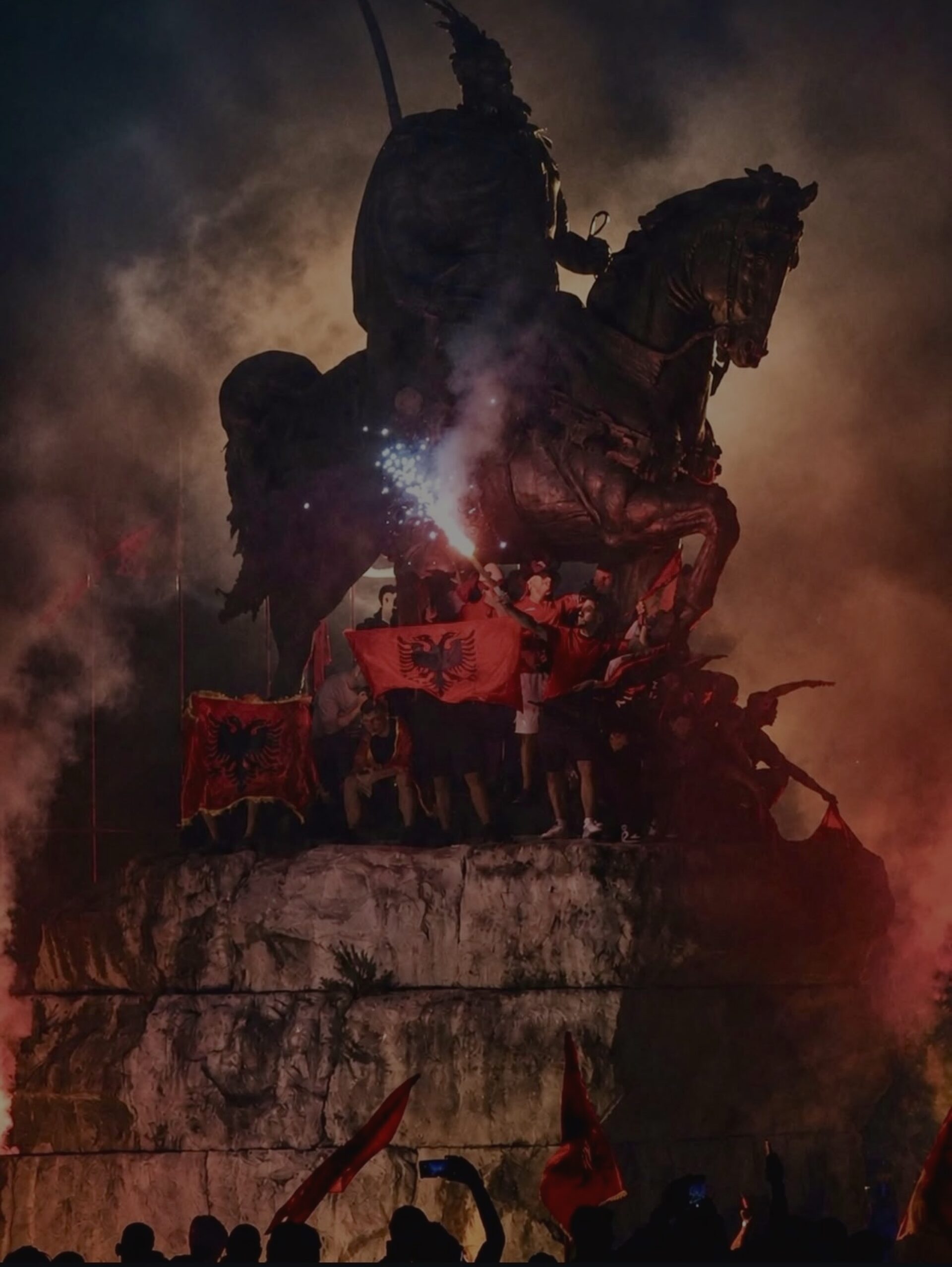
The world’s cameras found Albania this summer because of a beach, a billionaire’s son-in-law, and a flock of flamingos. Eleven weeks of nightly marches, the largest since the fall of communism, filed under “protests against a Kushner resort.”
The framing is convenient for everyone. It gives foreign editors a famous name for the headline. It gives the Prime Minister a foreign villain, and he has tried Iranians, bots, and antisemites in turn. And it lets the rest of Europe treat this as a zoning dispute with good visuals.
It is none of those things. Kushner is one customer. The protest is against the sellers, and the selling has been going on for thirty-five years.
The country that is disappearing
Start with the only statistic that matters, the one every other number in this article merely explains.
In 1991, when the dictatorship fell, Albania had about 3.2 million people and one of the youngest populations in Europe, a median age around 27. The 2023 census counted roughly 2.4 million. One quarter of the nation, gone. Around 1.7 million Albanians now live abroad, more than one in three of us. Fifty thousand leave every year. Albania’s statistical agency and the UN Population Fund put it plainly: the population falls by four people every hour, 91 every day, about 33,000 a year, one of the fastest-shrinking populations on earth.
Here is the number I cannot stop thinking about. In the early 1990s, Albania had 1,450,000 school-age children. Today it has about 400,000.
And here is the number that destroys every excuse. By official counts, the current wave of emigration rivals the exodus of the 1990s — the years when the country had no roads, no banks, and no functioning state. People are leaving democratic, EU-candidate, tourism-boom Albania at a pace that recalls the wreckage of communism. Nobody flees a country that works.
The men who governed those thirty-five years would like you to treat this as weather, a sad regional trend, the price of open borders. It is not weather. It is a verdict, delivered one suitcase at a time.
Both parties. One method.
This is the part that Albanian political tribalism and foreign simplification both get wrong. The protests filling Skanderbeg Square are not the opposition’s protests. Marchers have carried slogans against Edi Rama and against opposition patriarch Sali Berisha in the same breath, naming them as one establishment. When Berisha praised the movement as the most important in 35 years, the movement kept him at arm’s length. The crowd is not asking to swap dynasties. It has met both.
The record explains why. In 1997, under Berisha’s Democrats, the pyramid schemes collapsed with the savings of a huge share of the nation inside them, and the country fell into armed anarchy. By 2013, the end of his time in power, Albania had sunk to 31 out of 100 on Transparency International’s corruption index — 116th of 177 countries, one of the worst scores in Europe. Berisha has since been declared persona non grata by the United States over corruption allegations, indicted at home, and placed under house arrest. Former president Ilir Meta has been arrested too.
Then the Socialists’ turn. Thirteen years of Edi Rama have produced, at the time of writing: his handpicked Tirana mayor and presumed successor indicted and in detention, denying the charges. His former deputy prime minister a fugitive in Switzerland. Another deputy prime minister indicted over a tunnel tender and suspended by the Constitutional Court, then dismissed — while Rama attacked the anti-corruption prosecutors as though their case were a coup against his government. A US State Department assessment that procurement corruption remains common. Hundreds of millions sunk into waste incinerators that were never properly built.
Two parties, thirty-five years, and the leading figures of both under prosecution at once. Albania has absorbed years of Western assistance earmarked for fighting corruption. The money bought seminars. The class it was meant to restrain bought the coast.
Emptied to sell
Depopulation and corruption are usually told as two separate tragedies. They are one system, and the protests understand this even when the coverage does not.
A full country is hard to loot. Full countries have teachers’ unions, industrial workforces, young voters, people with the energy to object. An emptied country is a real estate portfolio.
So look at what thirty-five years of governance chose to build and chose to let die. The Ballsh refinery, once employing more than two thousand people, was left to serial looters, its workers owed more than a year of unpaid wages, until the state’s own councils signed off on dismantling it for a no-bid solar park. Albania now exports its crude oil and imports its gasoline. Education spending sits around 3 percent of GDP, among the lowest in Europe, while student numbers have fallen by nearly a third and rural schools close with the villages around them. Health spending per person is the lowest in the Balkans. Albanians pay roughly half their health costs out of pocket. The state’s own audit found empty shelves in the hospital pharmacies of five major cities. The average urban pension is about 200 euros a month, the rural one about 120, in a country where cancer patients report paying thousands of euros, and sometimes bribes, for drugs the public system was supposed to provide.
Now look at what the same state moves quickly on. A law written in 2022 to hand roughly 81 hectares of the Durrës port, free of charge, to an Emirati developer, exempt from any tender, negotiated in secret, with the private partner committing as little as nine percent of the financing. A law written in 2024 to open protected coastline to resorts tied to Kushner-affiliated companies, where fencing and clearing began before any environmental impact assessment was completed or final permit issued, in defiance of a European Parliament resolution demanding a moratorium. A law written in 2025 to transfer state mountain land for one euro. Villagers in Zvërnec found razor wire across the beach they had swum at all their lives. Families in Theth had their guesthouses demolished for lacking permits the broken land registry could never issue, while the investors’ projects were waved through by laws written directly for them, one tailor-made deal at a time.
That is the machine in full view. Schools, hospitals, industry, and pensions starved on one side. Land, laws, and exemptions delivered on the other. The people in between are offered a choice the government never says aloud: serve the estate or leave it. Hundreds of thousands have chosen the suitcase. The politicians did not plan the exodus. They profited from it, they governed as if it were a convenience, and in thirty-five years neither party has treated it as the emergency it is. Every discontented citizen who boards a ferry is one fewer voter, one fewer protester, one more family wiring euros home into an economy whose currency, the IMF notes, has strengthened in ways the real economy cannot fully explain.
The lie that lit the fuse
Every movement has a moment when the contempt becomes undeniable. Albania’s came in installments this summer.
It came when the Prime Minister, asked on British television whether the Zvërnec project existed — a project with its own law, its own site works, its own criminal investigation, and its own fences — insisted there was no project. It came when he likened the citizens marching outside his office, in writing, to “the screamers of Nazi Germany” and the “jackals of Golden Dawn.” It came when, on roughly the fortieth consecutive day of protests, his government found four million euros in the state reserve fund, without a tender, for a Kanye West concert, in the same season the state auditor confirmed the hospital pharmacies were empty.
The protesters’ five demands are worth reading, because none of them is “cancel the resort.” Resignation of the government. A non-partisan transitional administration with a twelve-month mandate. Constitutional and electoral reform, including term limits. Repeal of the special-investor laws. A new social contract between citizens and the state. That is not a movement against a hotel. That is a movement against the operating system.
We are the evidence
The marches are not only in Tirana. They are in the diaspora, in the cities of Europe and America where a third of the nation now lives, which is fitting, because the diaspora is not an audience to this story. It is the proof of it.
Every Albanian abroad is a data point in the case against the political class: someone for whom thirty-five years of promises could not produce a reason to stay. The politicians like the diaspora best at a distance, as a remittance stream and a summer tourism statistic. They should reflect on what it means that the evidence is now marching.
Foreign coverage will keep reaching for Kushner, because the name travels. But any billionaire could hold his role in this story, and the story would not change. Only one political class could have taken Europe’s youngest country and produced one of the world’s fastest-emptying ones. The people in the squares, in their eleventh week as this is written, are not asking Europe to dislike an American investor. They are asking for something much simpler and much larger: a state that stops selling what remains of the country out from under the people still in it.
A quarter of Albania is already gone. The marchers are what refused to leave, joined abroad by what was forced to. Between them, they are the country. The men in the palaces along the boulevard are only its tenants, and the lease is being read aloud, every night, in the square.