
On September 16, a panel in The Hague reads its verdict in the case of four men who, for much of the Albanian world, are not defendants but liberators: Hashim Thaçi, Kadri Veseli, Rexhep Selimi, and Jakup Krasniqi.
Whatever the panel decides, the day will be read as a verdict on more than four men. It will be read as a verdict on the war that freed Kosovo.
What the Kosovo Specialist Chambers are
The Specialist Chambers are a court seated in The Hague. They operate under Kosovo’s own law, but they are staffed by international judges and prosecutors and sit far from Kosovo’s borders. They were created in 2015, under pressure from Kosovo’s Western partners, to try alleged crimes linked to the Kosovo Liberation Army (KLA) during and after the 1998–99 war.
For many Albanians, the court has always carried a contradiction. It was built to judge the side that fought a war against ethnic cleansing — while the architects of that cleansing answered, if they answered at all, in other courts and other decades. That is the wound this verdict touches.
Who is on trial, and for what
The four are among the most senior political figures of the KLA. Hashim Thaçi went on to become president of Kosovo. The indictment charges all four with war crimes and crimes against humanity said to have been committed in 1998–99. Every one of them has pleaded not guilty.
The trial opened in April 2023 and ran for more than two years; the panel closed the evidence in December 2025. Prosecutors have asked for 45 years in prison for each man. The first-instance judgment is scheduled for the morning of September 16, at 10:00 in The Hague.
Why the diaspora is watching
This is not a case the Albanian diaspora can watch quietly. It reaches the legitimacy of the war for freedom itself — the war that emptied and then saved a generation.
Our position is not that courts should look away. It is the opposite. We ask for what we ask of every institution: a fair, transparent, and impartial process, held to the same standard applied to everyone. Standing with these men and demanding honest justice are not in tension. They are the same demand.
Why we gather on September 16
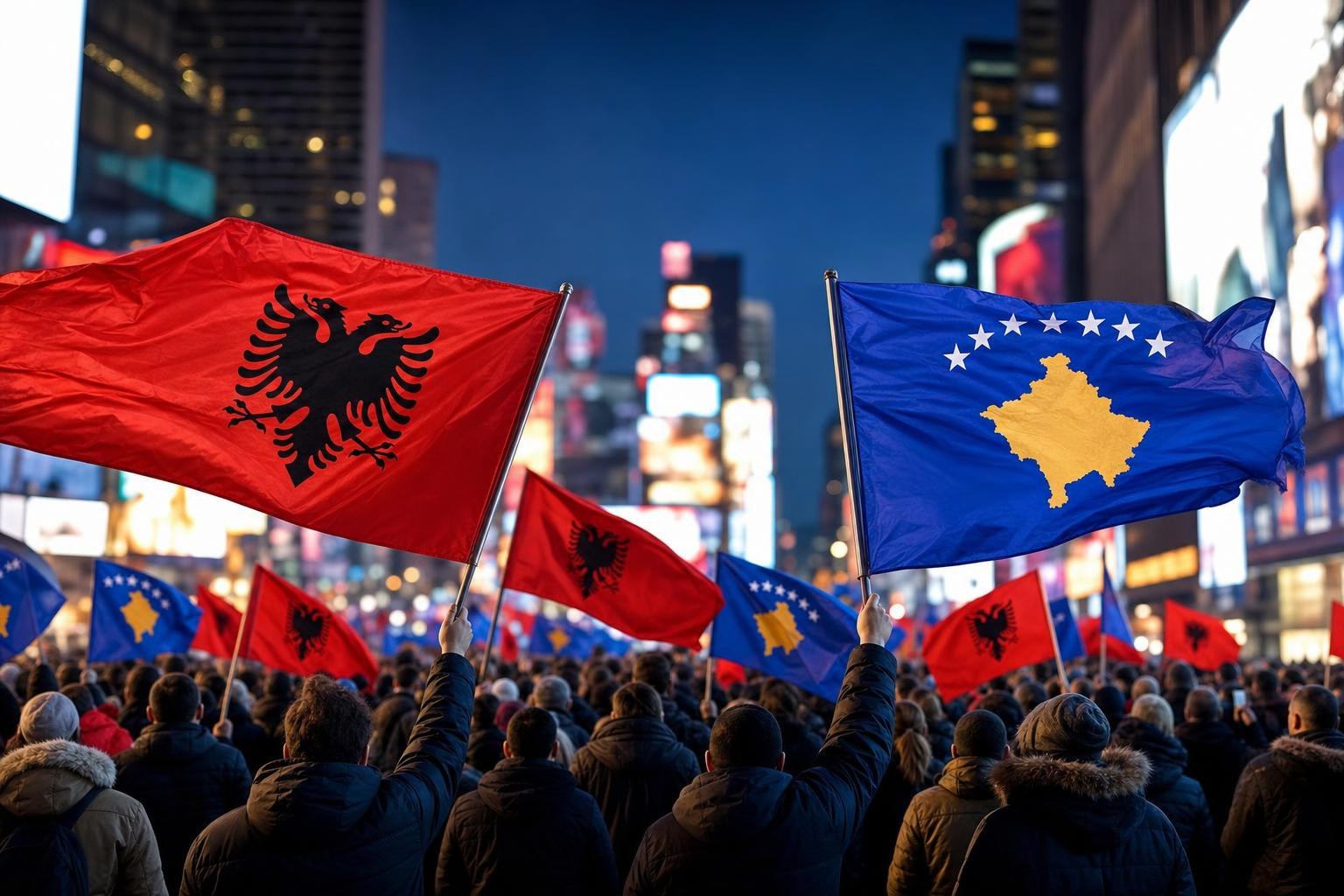
Whatever the verdict brings, the diaspora will gather that evening in Times Square. If the four walk free, we gather to celebrate. If the verdict falls the other way, we gather all the same — with dignity, and with one voice the world can hear from the center of New York.
One people. One history. One justice.