For thirty years, an Albanian who worked fourteen years in Fier and nineteen in Bergamo could reach 67 with thirty-three years of labor behind him and no pension from anyone. Albania requires a minimum of 15 insured years. Italy requires 20. He missed both thresholds, so both systems owed him nothing, and the contributions he paid in two countries simply evaporated.
That ended on 1 July 2025, when the social security agreement between Albania and Italy entered into force. It was signed by the two foreign ministers on 6 February 2024 and took ten years of negotiation to reach. Roughly 500,000 Albanian citizens who live in Italy or have worked there are covered, along with Italians who have worked in Albania. If you or your parents split a working life across the Adriatic, this is what it changes and what to do about it.
What the agreement does
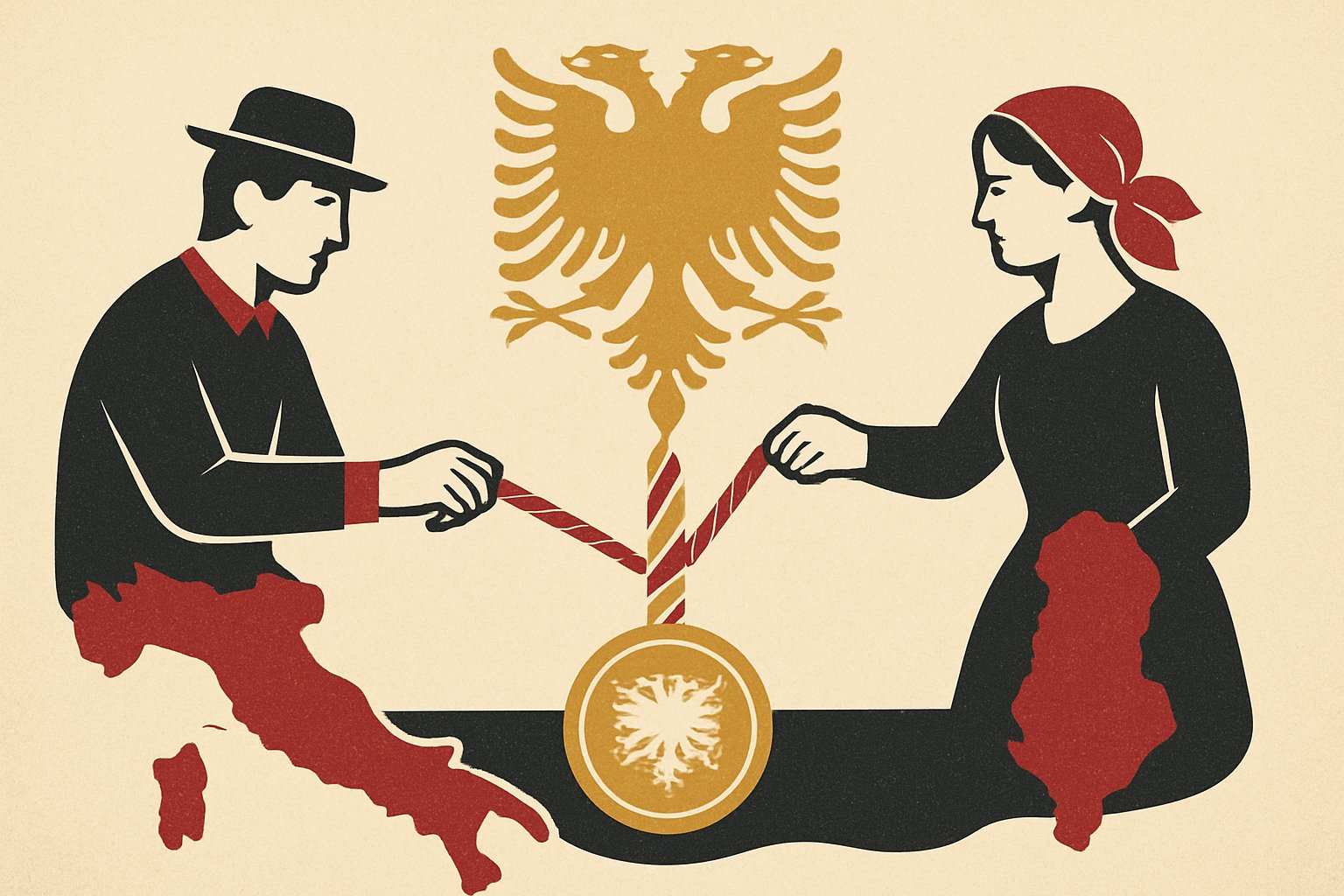
Your years now add up across both countries. If you don’t meet the minimum on either side, the two insurance histories are combined to establish your right to a pension. The man with 14 Albanian years and 19 Italian years is now treated as having 33, which clears both thresholds.
Each country pays its own share. This is the part people get wrong, so be precise with your relatives: nobody pays you for the other country’s years. Italy calculates a pension for the Italian years, Albania for the Albanian years, each under its own law, pro rata. You end up with two pensions, proportional to what you paid where.
Totalization applies when you need it. If you independently qualify in one country, that pension is calculated normally. The combining mechanism exists for the people who fall short, which is most of the first generation.
Periods under one year don’t stand alone. An insurance period shorter than 52 weeks in one country cannot generate a pension there by itself, but it still counts toward the combined total.
It covers more than old age. Invalidity and survivors’ pensions, sickness, maternity and unemployment benefits are in scope, double contributions for the same work are eliminated, posted workers stay in their home scheme for up to 36 months, and benefits are exportable between the two countries.
Already retired? You’re not excluded. People who reached pension age before the agreement can still apply to have their cross-border years recognized.
How to apply
One application, filed where you live, moves through both systems. You do not run two parallel processes.
If you are in Italy, apply through INPS and attach the documentation for your Albanian work years. If you are in Albania, apply through the Social Insurance Institute (ISSH), including via e-Albania, and ISSH forwards everything to INPS. Each institute verifies its own side and answers for its own share.
Documents to gather before you start:
- Your Albanian work booklet (libreza e punës) or whatever documents prove your employment history in Albania
- For Albanian insurance periods before 2012, a signed employment history declaration (Deklaratë e Historikut të Punësimit) is mandatory, per INPS Circular No. 106 of 2025, along with any supporting employment records
- A copy of your Albanian identity document, so the Albanian institute can identify you precisely
- Bank account details showing the account holder where payment should land
- For dependent family members who never worked in Italy, a verified copy of their Italian fiscal code
INPS and ISSH have published a joint guide to the agreement in Albanian; it is hosted on the INPS website and worth reading before you file.
The free help almost nobody uses
Italian patronati are advice offices funded by the Italian state to help workers with exactly this, at no cost to you. UIM Albania (linked to the Italian union UIL, through ITAL and Ital UIL) has opened desks in several Albanian cities — Tirana, Durrës and Vlorë among them — specifically for Albanian-Italian pension cases, funded by the Italian Ministry of Labor. They can see your INPS contribution record, coordinate with ISSH, and file the application for you. In Italy, any patronato office does the same. If your parents are the ones retiring, this is the errand to do with them, because the service is free and the paperwork is not simple.
Do this now, even if retirement is years away
Request your contribution statement from both sides and check it while the employers still exist and the witnesses are still alive. Albanian records from the 1990s are the weak link: the ISSH itself acknowledges that documents from the transition years are riddled with gaps and corrections that require verification. A missing year found at 50 is an annoyance. A missing year found at 67 is income you may never recover.
The part that took ten years
Sit with that number for a moment. The negotiation opened in 2015 and the agreement reached force in 2025. Half a million people waited ten years for their own governments to agree that their work counted, and for all ten of those years, not one member of Albania’s Parliament held a seat that depended on their votes. The deal came, eventually, as a favor of diplomacy. With a diaspora electoral district, it would have come as a demand with a deadline. Greece, where the wait is still going, is the proof, and it is the next article.
Make the next deal a demand, not a favor. Add your name and your home district — get counted as a voter, not just a supporter.